We value your privacy
On our website, we use services (including from third-party providers) that help us to improve our online presence. The following categories of cookies are used by us and can be managed in the cookie settings. We need your consent before being able to use these services. Alternatively, you may click to refuse to consent, or access more detailed information and change your preferences before consenting. Your preferences will apply to this website only. You can change your preferences at any time by clearing your browser history/cache or visiting our privacy policy page.
By authorizing third-party services, you allow the placement and the reading of cookies and the use of tracking technologies required to keep our website reliable and secure.

The case and bracelet on the new versions of the Oyster Perpetual 28 and Oyster Perpetual 34 are primarily satin finished. This aesthetic feature of models in the current Oyster Perpetual range lends their surfaces a softly textured sheen. It is the first time that the satin finish has been employed on timepieces fashioned entirely in precious metal. The domed bezel, with its polished finish, gleams in all its splendor.
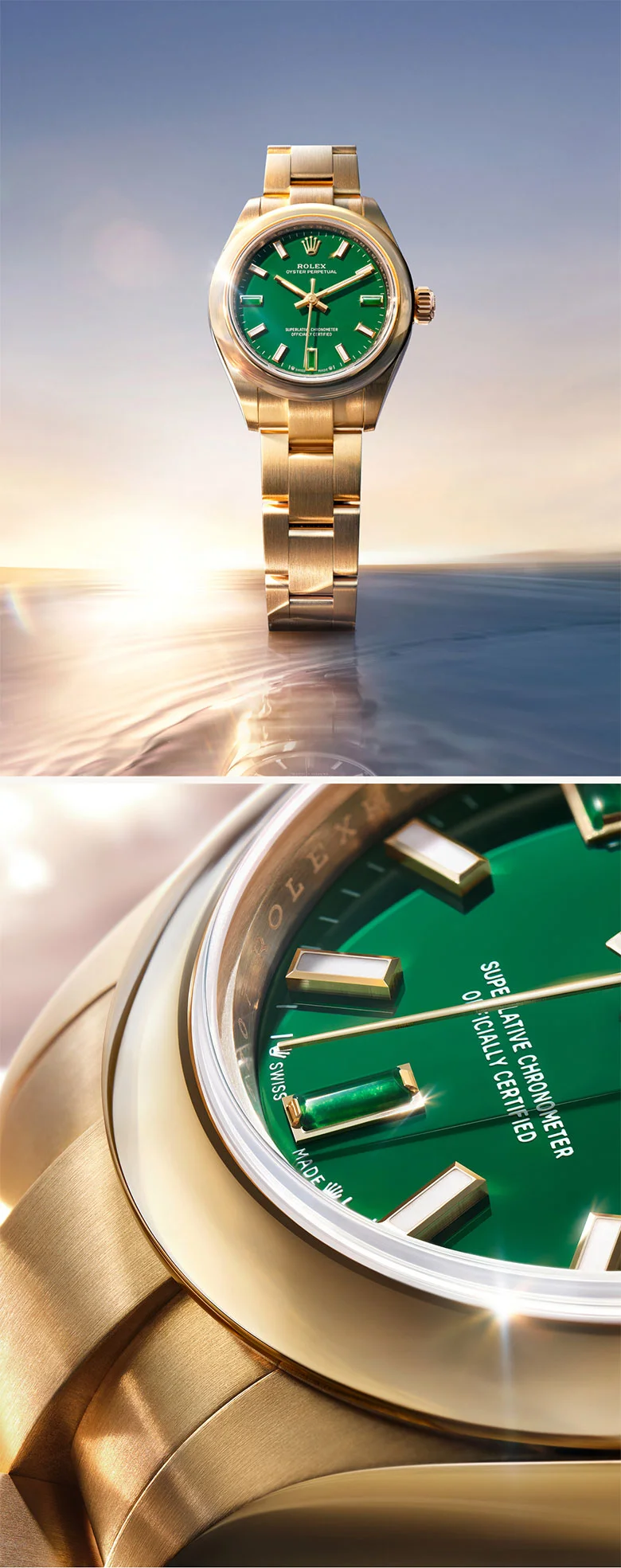
Unique in the watchmaking world, Rolex has chosen to be in complete control of the creation, casting and shaping of its 18 kt gold alloys by installing its own foundry. This allows the brand to produce gold alloys of the highest quality, notable for their exceptional purity and shine. 18 kt gold, an alloy eminently suitable for watchmaking, is composed of 750 ‰ (thousandths) of pure gold. According to the proportion of silver, copper or other elements added, different types of gold are obtained: yellow gold, white gold or Everose gold, the patented pink gold alloy developed by Rolex.
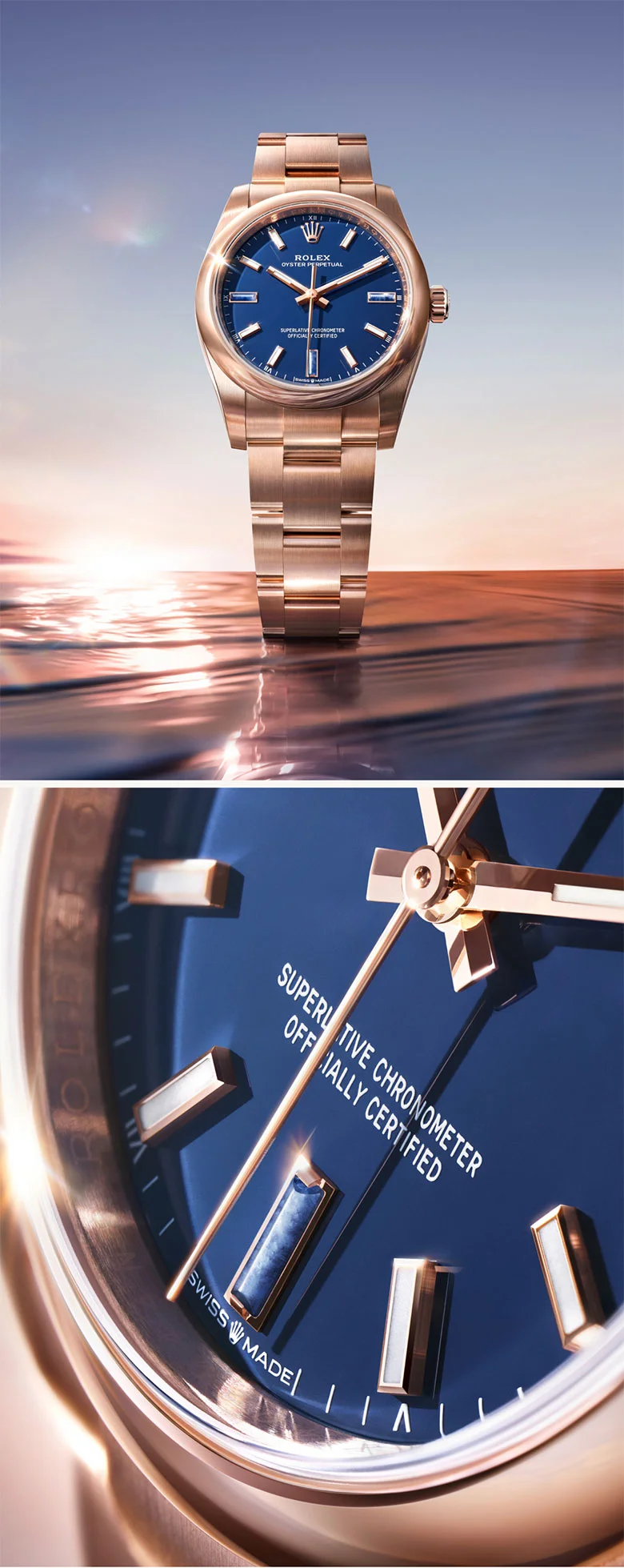
On the lacquer dials of some new versions of the Oyster Perpetual 34 and Oyster Perpetual 28 in 18 kt gold, three of the hour markers - those at 3, 6 and 9 o'clock - are in natural stone, a first for Rolex. The stones feature an ogive cut on their upper surface, which highlights their individual structure and color while preventing the slightest reflection.
On the Oyster Perpetual 28 in 18 kt yellow gold with a green stone lacquer dial, these three hour markers are in heliotrope, a stone presenting a variety of green hues. On the Oyster Perpetual 34 in 18 kt Everose gold with a blue stone lacquer dial, they are crafted from dumortierite, a mineral characterized by alternating areas of light and dark blue.
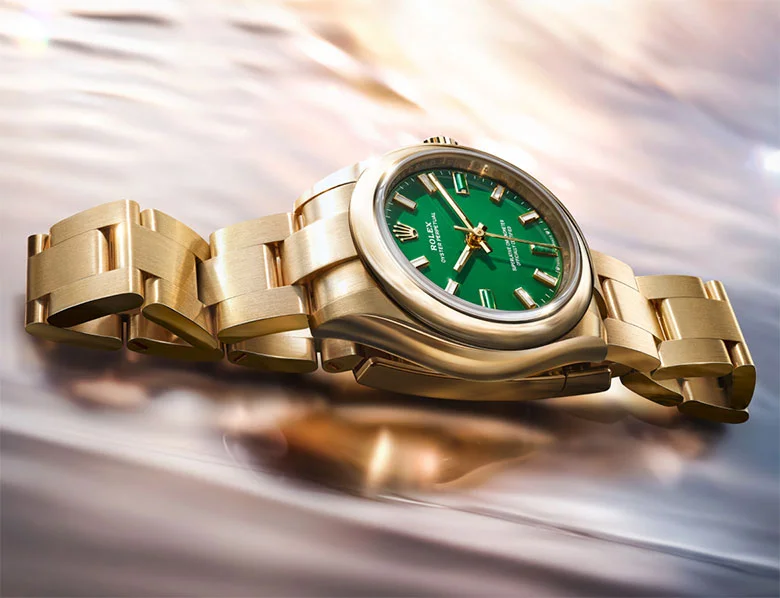
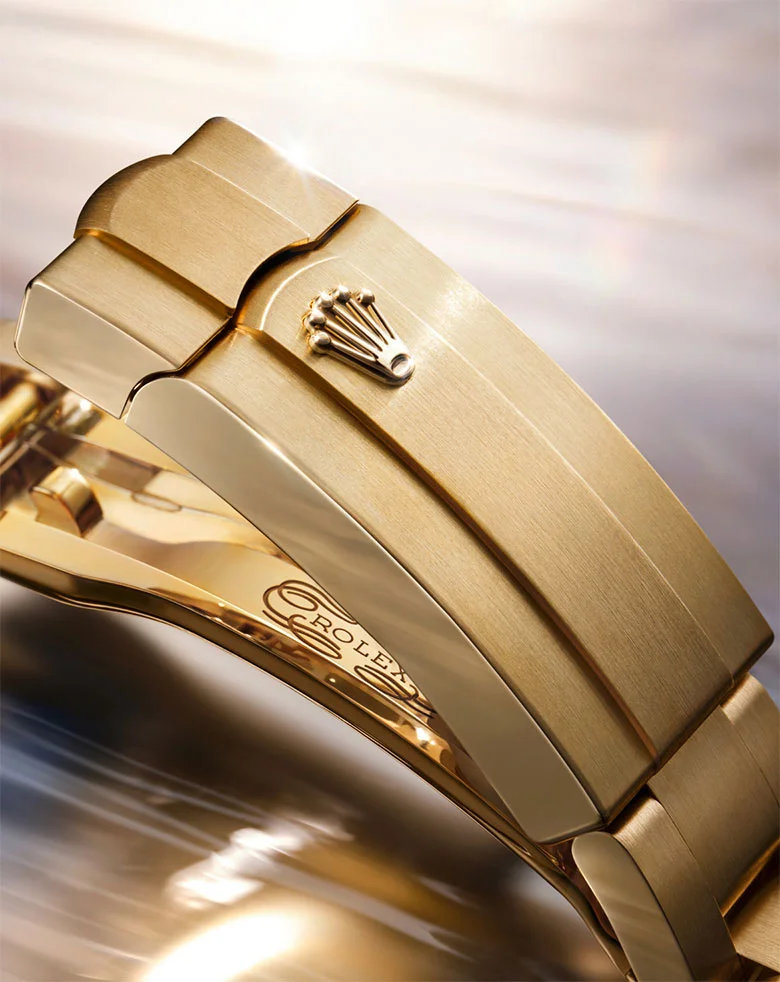
The new versions of the Oyster Perpetual 28 and Oyster Perpetual 34 are fitted on an Oyster bracelet. Developed in the late 1930s, this three-piece link bracelet is known for its robustness. On these watches, it is equipped with a folding Oysterclasp and also includes the Easylink comfort extension link, developed by the brand, which allows the wearer to easily adjust the bracelet length by approximately 5 mm.
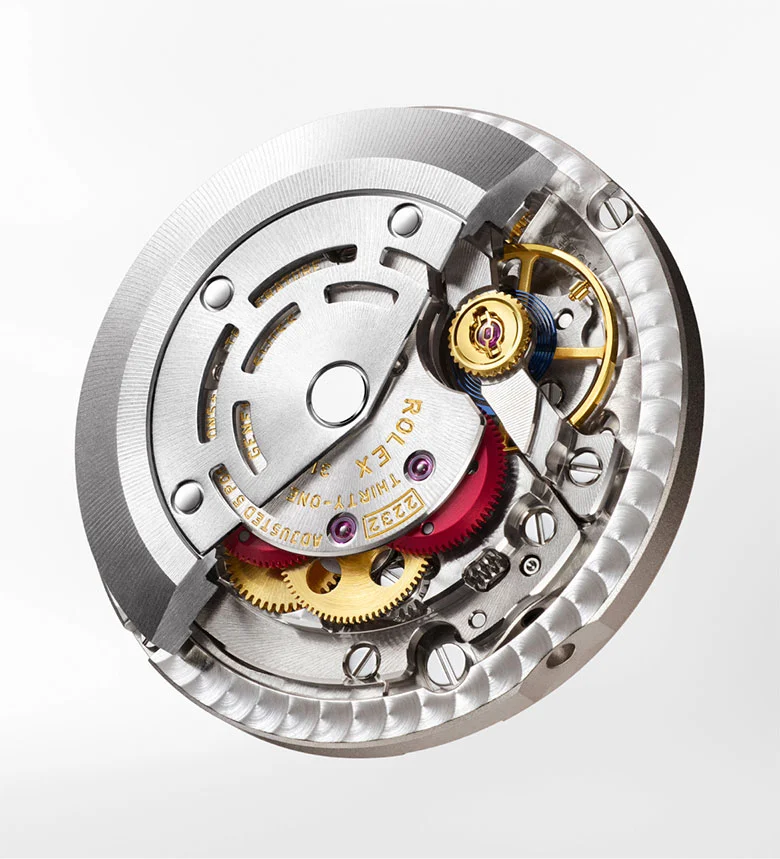
The Oyster Perpetual 28 and the Oyster Perpetual 34 are equipped with caliber 2232, a movement entirely developed and manufactured by Rolex. This self-winding mechanical movement delivers outstanding performance, particularly in terms of precision, autonomy, convenience and reliability. Fitted with the Syloxi hairspring and with a paramagnetic nickel-phosphorus escape wheel, caliber 2232 offers a power reserve of approximately 55 hours.
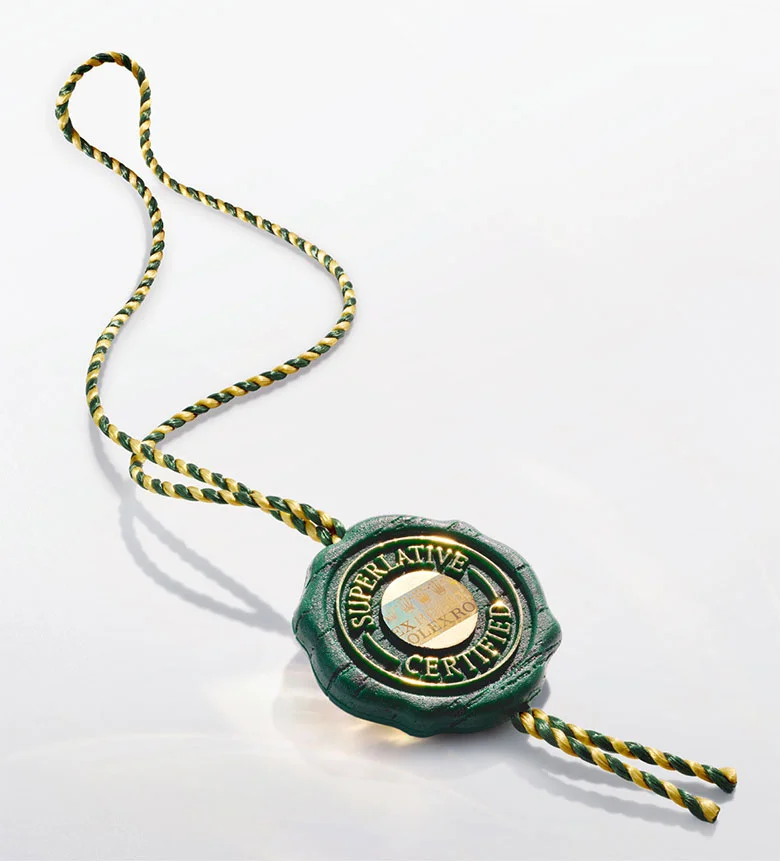
The Oyster Perpetual 28 and Oyster Perpetual 34 are covered by the Superlative Chronometer certification. This exclusive designation is issued to each watch leaving the Rolex workshops, attesting to its excellent performance on the wrist. This in-house certification is strictly controlled by internationally recognized, independent Swiss entities.
In 2026, the Superlative Chronometer certification has been strengthened with the addition of three new testing criteria: resistance to magnetism, reliability and sustainability. These criteria are implemented throughout the design and manufacturing stages of each timepiece – hundreds of checks and validations directly related to the watch’s performance are carried out during these phases. They supplement the criteria established when the certification was redefined in 2015 governing precision, waterproofness, self-winding and power reserve. That year, Rolex set up an exclusive testing protocol for its finished watches, conducted inside the manufacture on fully automated equipment. The precision requirements are particularly stringent: measured after casing the movement, the watch’s accuracy must be between –2 and +2 seconds per day. The rate deviation tolerated by the brand for the precision of a finished watch is significantly smaller than that accepted for official certification of the movement alone.
The Superlative Chronometer status is symbolized by the green seal that comes with every Rolex watch and is coupled with an international five-year guarantee.